
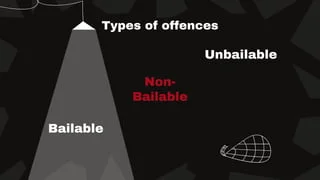
A family member gets arrested, and the first panicked question everyone asks is — “can we get bail immediately?” The honest answer is: it depends entirely on what kind of offence it is.
Understanding bailable and non bailable offence categories isn’t just legal trivia — it directly decides how fast someone can get out of custody, and whether it’s even a straightforward process or something requiring a full court hearing. Let’s break it down clearly.
What Is a Bailable Offence?
Direct answer: A bailable offence is one where bail is a legal right, and the accused can be released by the police station itself on furnishing bail, without needing to approach a court, as classified under the First Schedule of the CrPC (now BNSS, 2023).
These are generally less serious offences. Think simple hurt, defamation, public nuisance, or minor cheating cases.
What Is a Non-Bailable Offence?
Direct answer: A non-bailable offence is a more serious crime where bail is not a right but a discretion of the court, requiring the accused to formally apply for bail before a magistrate or higher court.
Murder, rape, dacoity, and serious drug offences fall under this category. The police cannot release the person directly — only a court can decide.
Why Does This Classification Even Exist?
I get asked this a lot. The logic is fairly simple — offences are graded by severity, and the more serious the crime, the more scrutiny is needed before releasing someone back into society, even temporarily.
It’s not a perfect system, honestly. I’ve seen cases where technically non-bailable offences involved relatively minor factual disputes, yet the accused sat in custody for weeks purely because of procedural delays.
Key Differences at a Glance
| Aspect | Bailable Offence | Non-Bailable Offence |
| Bail granted by | Police or Court | Only Court |
| Bail as a right | Yes | No, discretionary |
| Severity | Generally less severe | Generally serious/heinous |
| Examples | Simple hurt, defamation | Murder, rape, dacoity |
| Process speed | Fast, often same day | Can take days to weeks |
How Does the Process Differ in Practice?
For a bailable offence, here’s roughly how it works:
- Person is arrested
- Police inform them of the right to bail
- Bail bond and sureties (if required) are furnished
- Person is released, usually within hours
For a non-bailable offence, the process looks different:
- Person is arrested and produced before a magistrate within 24 hours
- Bail application is filed (regular bail or anticipatory bail depending on timing)
- Court hears arguments from both sides
- Judge decides based on factors like flight risk, evidence tampering possibility, and severity
Picture a situation where two neighbours in Jaipur get into a heated argument that turns physical, resulting in a simple hurt case. That’s usually bailable — released same day. Now compare that to a case involving grievous hurt with a weapon, which could shift into non-bailable territory depending on the specific section applied.
Anticipatory Bail — A Special Category
Worth mentioning separately. If someone fears arrest in a non-bailable offence, they can apply for anticipatory bail under Section 438 CrPC (now Section 482 BNSS) even before arrest. This is a pre-emptive legal protection, commonly used in cases involving business disputes turned criminal, or false FIRs.
Can Non-Bailable Offences Ever Get Easy Bail?
Yes, surprisingly. Not every non-bailable offence means automatic denial of bail. Courts consider:
- Nature and gravity of the offence
- Criminal history of the accused
- Possibility of the accused fleeing or tampering with evidence
- Health, age, and personal circumstances
I’ve noticed courts becoming somewhat more liberal with bail in recent years, especially in cases where investigation is complete and trial delays are long — the Supreme Court has repeatedly emphasized that “bail is the rule, jail is the exception.”
Which Sections Determine the Classification?
The classification (bailable or non-bailable) is specified against each offence in the First Schedule of the CrPC/BNSS. It’s not left to interpretation — it’s explicitly listed offence by offence, which is actually helpful for lawyers and the accused alike.
[link to related guide on how to file an FIR here]
FAQs
Who decides if an offence is bailable or non-bailable? The classification is fixed under the First Schedule of the CrPC (now BNSS, 2023), listed against each specific offence.
Can police grant bail in a non-bailable offence? No, only a court has the authority to grant bail in non-bailable offences; police cannot release the accused directly.
What is anticipatory bail? It’s bail sought before arrest, applicable typically in non-bailable offences, to prevent arrest while investigation is pending.
Is murder a bailable or non-bailable offence? Murder is a non-bailable offence, and bail can only be granted by a Sessions Court or High Court, not a magistrate directly in most cases.
How long does it take to get bail in a bailable offence? Usually a few hours, since it’s the accused’s legal right and can often be processed at the police station itself.
Can a non-bailable offence later become bailable? The classification itself doesn’t change, but courts can still grant bail based on case circumstances despite the offence being non-bailable.
Conclusion
Knowing the difference between a bailable and non bailable offence genuinely changes how you or your family should react in a crisis — one means quick police-level release, the other means preparing for a court hearing. If you’re ever in this situation, don’t waste time guessing; contact a criminal lawyer immediately so the right bail application gets filed without delay.